John the Baptist in the Gospel of John: A Voice Crying in the Wilderness
He comes into the Gospel announcing that he is not the point.
That is a strange way to introduce a character. Matthew gives John the Baptist a burning sermon and a confrontation with the Pharisees. Mark opens his entire Gospel with the Baptist in the wilderness, the whole Judean countryside coming out to hear him. Luke gives him an origin story: the angel, the elderly parents, the leap in the womb. In the other three Gospels, he is a vivid and fully realized figure in his own right.
John’s Gospel strips all of that away.
Here, the Baptist arrives already in mid-testimony, already pointing away from himself, already insisting on what he is not before anyone has asked. He is not the light. He is not the Messiah. He is not Elijah. He is not the prophet. He is a voice. A voice crying in the wilderness. That is all he will claim for himself, and it is, in this Gospel, exactly enough.
The fourth Gospel gives John the Baptist less biographical material than any of the others. It gives him something more theologically precise: a function, a title, and two declarations that have echoed across two thousand years of Christian art, liturgy, and devotion.
“Behold the Lamb of God.”
“He must increase. I must decrease.”
A man who understands his entire existence as preparation for someone else’s arrival. A voice that exists to fall silent. A finger that points and then withdraws.
In John’s Gospel, this is not diminishment. It is the highest possible vocation.
Key Facts: Who Was John the Baptist in Biblical History?
-
John, called the Baptist, a prophet and the forerunner of Jesus; son of the priest Zechariah and Elizabeth
-
The witness sent to testify to the light; the one who prepares the way and identifies Jesus as the Lamb of God
-
The Jordan River, where he is baptizing when the religious authorities come to question him and when Jesus first appears
-
Active at the beginning of Jesus’ public ministry; his final testimony in John’s Gospel comes in chapter 3
-
John’s Gospel assigns him a precise theological role — not prophet, not Messiah, not Elijah, but witness; the one who sees the Spirit descend and identifies the Lamb of God to his own disciples
The Witness and the Forerunner: Understanding His Identity in the Prologue
The Gospel of John opens with a Prologue that moves in vast, cosmic strokes — the Word, the beginning, the light, the darkness. And then, without transition, a man appears.
There was a man sent from God whose name was John.
The shift is deliberate and striking. We have just been told that the Word was with God before creation, that through Him all things came to be, that He is the light that shines in the darkness. And now: a man. Sent. Named John.
The Prologue is careful to establish immediately what this man is not. He was not the light. He came to testify to the light. He came so that all might believe through him. He is not the source. He is the witness. This distinction — between the light itself and the one who points to the light — is the whole of John the Baptist’s role in this Gospel, and it is established before he speaks his first word.
What follows in the narrative bears this out with remarkable consistency. Every time John the Baptist opens his mouth in this Gospel, he is either denying that he is something or pointing to someone else. He never speaks about himself in positive terms. He never claims a title. He never performs a sign. He simply witnesses. He sees, and he says what he sees, and he steps aside.
For John the Evangelist, this is not a minor supporting role. It is a model of the only kind of human life that makes theological sense in a Gospel where Jesus is the Word made flesh. If Jesus is who John says he is, then the appropriate human response is exactly what the Baptist demonstrates: to see Him clearly, to say so plainly, and to make room for Him.
Major Biblical Scenes: From the Interrogation at the Jordan to the Emptying Platform
John the Baptist makes only a handful of appearances in the Fourth Gospel, but each one serves a singular, razor-sharp purpose. Across these key moments, we watch a man who refuses every opportunity for self-promotion or power, choosing instead to repeatedly and clearly direct the world's gaze toward the true Light.
-
John 1:19–28
The priests and Levites come from Jerusalem to ask him who he is. The question is direct: “Who are you?”
And John confessed and did not deny it, but confessed: “I am not the Messiah.”
The double confession — he confessed and did not deny, but confessed — is John the Evangelist’s way of underlining the Baptist’s clarity. He is not hedging. He is not being modest in a way that invites further inquiry. He is stating plainly and without ambiguity what he is not.
“Are you Elijah?”
“I am not.”
“Are you the Prophet?”
“No.”
“Then who are you? What do you say about yourself?”
“I am the voice of one crying out in the desert: ‘Make straight the way of the Lord.’”
He borrows the language of Isaiah and applies it to himself. Not a name, not a title, not a biography. A function. A voice. The voice is not the message — it is the medium through which the message travels. And when the message has been delivered, the voice falls silent.
The priests press further: “Why then do you baptize if you are not the Messiah or Elijah or the Prophet?”
And he says: “I baptize with water, but among you stands one whom you do not recognize, the one who is coming after me, whose sandal strap I am not worthy to untie.”
He is already here. You do not recognize him. That is the Baptist’s announcement: the one you are waiting for is already in your midst, and you are asking the wrong person the wrong questions.
-
John 1:29–34
The next day, Jesus comes toward him, and John the Baptist says the words that have become one of the most recognizable phrases in the entire Catholic liturgy:
“Behold the Lamb of God, who takes away the sin of the world.”
Two things happen in this sentence. First, John identifies Jesus. He points. Behold — look, see, here He is. The one I have been testifying about. The one you did not recognize. Here.
Second, he names what Jesus is and what he will do. The Lamb of God. Not a lamb — the Lamb. The definitive, once-for-all sacrifice that all the lambs of the Temple and the Passover have been pointing toward. And He takes away the sin of the world — not the sins of Israel, not the sins of the righteous, not the sins of those who observe the law correctly. The sin of the world.
John the Baptist then describes what he has seen: the Spirit descending like a dove from heaven and remaining on Jesus. He did not know him before this, he says — the one who sent him to baptize told him that the man on whom he sees the Spirit descend and remain is the one who will baptize with the Holy Spirit. And he has seen it. And so he testifies: this is the Son of God.
In four verses, the Baptist has given us the two most important titles Jesus carries in this Gospel — the Lamb of God and the Son of God — and grounded them in what he personally witnessed. He is not speculating. He is not inferring. He saw the Spirit descend. He is reporting what he saw.
This is the function of a witness. And it is the only function John the Baptist claims for himself.
-
John 1:35–37
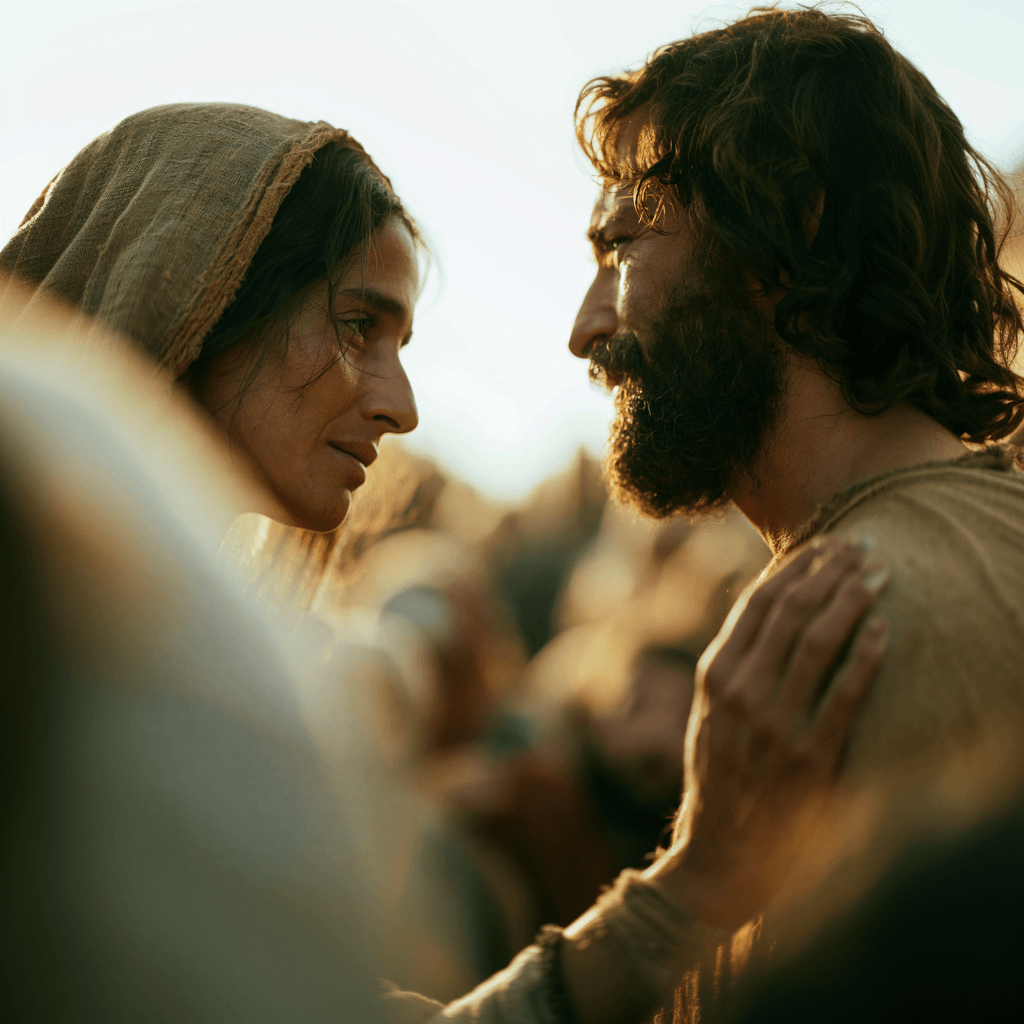
The day after, John is standing with two of his disciples when Jesus walks by.
He points again. Behold the Lamb of God.
The two disciples hear him say this, and they follow Jesus.
This is the entirety of the scene. The Baptist points. The disciples leave him and follow someone else. And he lets them go.
One of those two disciples is Andrew, who will go to find his brother Simon Peter. The other, most scholars believe, is the author of this Gospel — the beloved disciple, John himself, who begins his journey with Jesus because John the Baptist pointed and stepped aside.
The man who writes this Gospel is, in a sense, a direct product of the Baptist’s willingness to decrease. His greatest disciple leaves him to follow the one he has been pointing to all along. And John the Baptist does not object. This is exactly what he was for.
-
John 3:22–30
The final scene of John the Baptist in this Gospel is a conversation with his disciples about Jesus baptizing nearby and everyone going to Him.
“Rabbi,” they say, “the one who was with you across the Jordan, to whom you testified — here He is baptizing, and everyone is coming to Him.”
There is something almost plaintive in the way the disciples report this. They are loyal to the Baptist. They followed him. And now they are watching his followers migrate to someone else. They seem to expect him to be troubled by it.
He is not troubled by it. He explains why with one of the most luminous images in the Gospel:
“The one who has the bride is the bridegroom. The best man, who stands and listens for him, rejoices greatly at the bridegroom’s voice. So this joy of mine has been made complete. He must increase; I must decrease.”
The best man at a wedding does not compete with the groom. His role is to prepare, to announce, to step aside, to rejoice when the groom arrives. His success is measured entirely by the groom’s presence. The moment the groom appears, the best man’s work is done — and that is a reason for joy, not grief.
He must increase. I must decrease.
Six words. The complete theology of John the Baptist’s vocation, and one of the clearest statements in the New Testament of what it looks like to orient an entire human life around someone other than yourself.
This is the last time John the Baptist speaks in the fourth Gospel. He has said everything he needed to say. He steps aside. The rest of the Gospel belongs to the one he was pointing toward.
Theological Themes: What John’s Gospel Emphasizes About the Witness
Unlike the other Gospels that paint a vivid portrait of a fiery desert preacher, the Fourth Gospel radically narrows its focus. By stripping away the Baptist's backstory and wilderness sermons, John forces our attention entirely onto the man's theological purpose—revealing a figure defined not by what he achieves, but entirely by who he points to.
-
John the Evangelist makes a point of noting that John the Baptist performed no signs. In chapter ten, after Jesus has withdrawn beyond the Jordan, the people say: “John performed no sign, but everything John said about this man was true. And many there began to believe in Jesus.”
This is a theological statement embedded in a passing observation. The Baptist’s authority comes not from miracles but from testimony. He saw, and he said what he saw, and what he said turned out to be true. His credibility is the credibility of the honest witness — the person who reports what they actually observed, without embellishment, without self-interest, and without flinching when the testimony costs them something.
-
Every character in John’s Gospel is, in some sense, an illustration of a possible response to Jesus. Nicodemus comes by night and moves slowly toward the light. Mary Magdalene stays when others leave and is the first to see. Pilate asks the right question and walks away.
John the Baptist illustrates the response of someone who clearly understands from the beginning who Jesus is and what that means for everyone else. His response is immediate recognition, honest testimony, and joyful self-effacement. He does not grasp. He does not compete. He points, steps aside, and calls it the completion of his joy.
In a Gospel that repeatedly asks whether people will believe, John the Baptist is the figure who believed before anyone else and whose belief took the form of pointing others to the one he believed in.
-
The words John the Baptist speaks on the banks of the Jordan have become permanently embedded in the Catholic liturgy. At every Mass, before the distribution of Communion, the priest elevates the host and says: “Behold the Lamb of God, behold him who takes away the sins of the world. Blessed are those called to the supper of the Lamb.”
The congregation responds: “Lord, I am not worthy that you should enter under my roof, but only say the word and my soul shall be healed.”
The Baptist’s words have been spoken at every Mass in the Roman Rite for centuries. They are spoken in the present tense, as an act of recognition: here, now, in this bread and this wine, behold the Lamb of God. The pointing continues. John the Baptist’s gesture — that extended arm toward Jesus on the banks of the Jordan — is repeated at every altar, at every Mass, in every language the Church speaks.
He must increase. The Church has made sure of it.
Liturgical Legacy: The Catholic Tradition, Feasts, & Patronage
The Church celebrates two feasts of John the Baptist — his birth on June 24 and his martyrdom on August 29. He is one of only three people whose birth the Church celebrates liturgically, alongside Jesus and Mary. This is a significant honor and reflects the Church’s understanding of the Baptist as a figure of unique importance in salvation history.
His birth feast on June 24 falls six months before Christmas, reflecting the six-month gap between his birth and the birth of Jesus, as recorded by Luke. The liturgical calendar encodes the relationship between the forerunner and the one he prepares the way for.
He is the patron saint of numerous countries, cities, and religious communities, and his image — the wild prophet with the lamb and the reed cross — is one of the most recognizable in the history of Christian art. Leonardo da Vinci painted him. Caravaggio painted him. Rodin sculpted him. He is a figure that has fascinated artists as much as theologians, because the combination of prophetic intensity and radical self-effacement is both visually compelling and spiritually demanding.
The Catechism of the Catholic Church calls John the Baptist the greatest of the prophets and the last of them — the hinge between the Old and New Testaments, the one who stands on the boundary and points across it (CCC 523–524). In him, the long line of prophets who prepared the way reaches its end. The one they were preparing the way for has arrived. And John the Baptist is the first to see Him and say so.
Why His Story Matters: The Radical Vocation of Stepping Aside
There is a kind of person the world does not quite know what to do with: the one who is genuinely content to be second. Who prepares something magnificent and then steps aside and lets someone else inhabit it. Who experiences the departure of their own followers as the completion of their joy rather than the diminishment of their life’s work.
John the Baptist is that person. And in a culture that measures significance by visibility, by platform, by how many people are following you rather than by how many people you pointed them toward, his vocation is quietly radical.
He came to testify to the light. He testified. He pointed. He decreased.
And two thousand years later, at every Mass in every Catholic church in the world, a priest elevates the host and says his words:
“Behold the Lamb of God, who takes away the sins of the world.”
The voice that cried in the wilderness is still crying. The finger that pointed to the banks of the Jordan is still pointing.
He must increase.
The Baptist is still making sure of it.