The Gospel of John: A Narrative Overview & Retelling
Before anything else, there was a word.
Not a sound. Not a letter scratched into clay or papyrus. A word in the deepest sense of the thing — a thought expressed, a meaning given form, an intention made real. And this word, John tells us, was not spoken by God. It was with God. It was God.
John does not ease you in. He does not begin in a stable in Bethlehem or on a riverbank in the Judean wilderness. He begins at the place where beginning itself began. And then, with one sentence that should stop every reader cold, he says that this eternal word — this divine, uncreated, universe-making word — became flesh.
It pitched a tent among us.
That is what the Greek actually says. The Word tabernacled. It moved into the neighborhood. And those who were there, John says, saw its glory.
He was one of them.
Part One: The Seven Signs and Miracles in John’s Gospel
The Voice in the Wilderness: John the Baptist and the Lamb of God
John 1:19–51
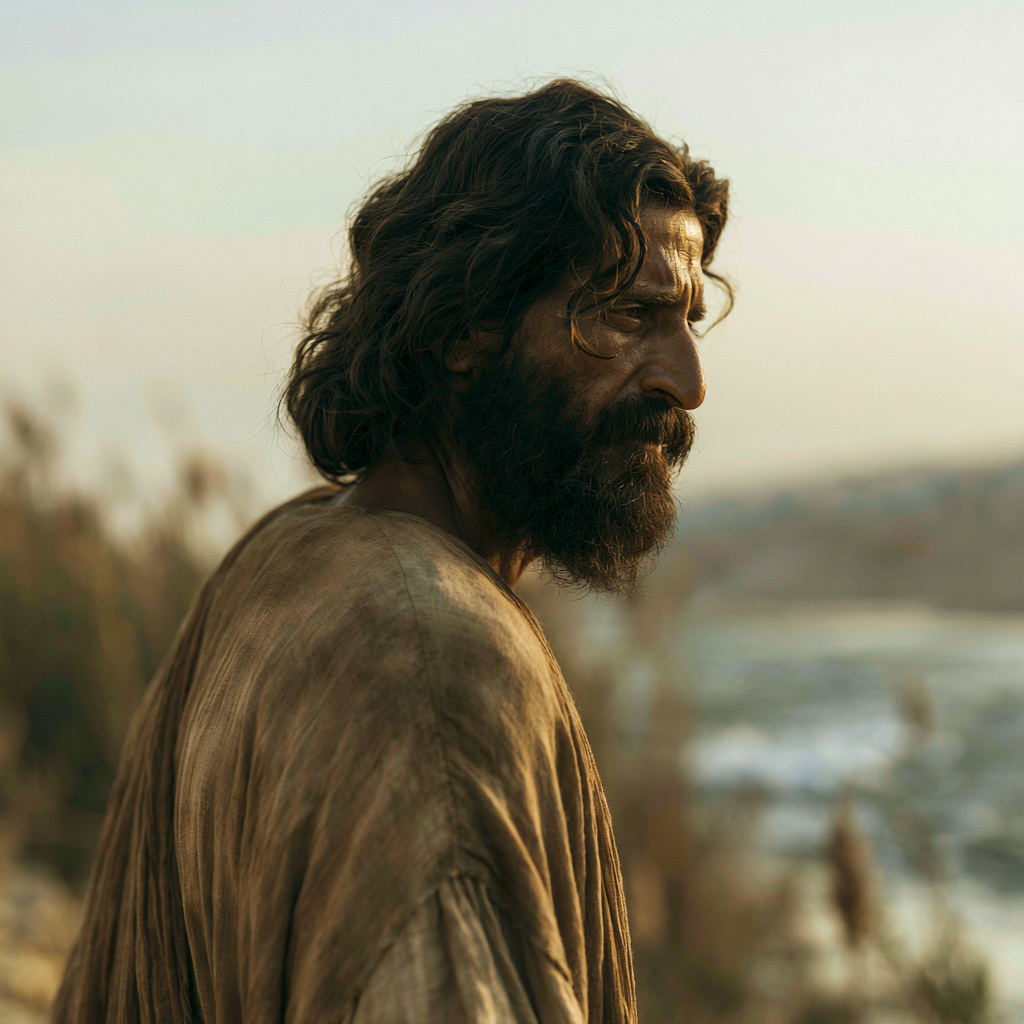
The story proper begins on a riverbank, where a wild-eyed prophet named John the Baptist is telling anyone who will listen that the one they have been waiting for is already among them. He is not the light, he says. He is only a voice crying in the wilderness. The light is coming.
Then Jesus appears, and the Baptist points: there. Behold the Lamb of God. The one who takes away the sin of the world.
A handful of men follow Jesus home that afternoon. Andrew is one of them. He runs to find his brother Simon and says only, " We have found Him. The Messiah. And Jesus looks at Simon for the first time and gives him a new name. You are Peter, He says. The Rock. As if He already knows what this man will become, and what he will fail to be, and what grace will make of him in the end.
The Wedding at Cana: The First Sign and Water Into Wine
John 2:1–12
The first sign happens at a wedding.
It is in Cana, a small town in Galilee, and the wine has run out. This is not a trivial problem. In the ancient world, a host who ran out of wine at his own wedding feast brought shame on his family that could last for years. Jesus’ mother finds Him and says simply: They have no wine. ” She does not ask for a miracle. She does not need to. She just tells Him the problem, then turns to the servants and says, "Do whatever He tells you."
There are six stone water jars standing nearby, each one holding twenty or thirty gallons, used for the Jewish rites of purification. Jesus tells the servants to fill them to the brim. “Then draw some out,” He says, “and take it to the headwaiter.”
The headwaiter tastes it and does not know what has just happened. He calls the bridegroom over, puzzled, delighted. “Everyone serves the good wine first,” he says. You have kept the good wine until now.
John calls this the first of the signs. Jesus revealed His glory, he writes, and His disciples believed in Him. The water becoming wine is not just an act of generosity. It is the announcement of a new age — the old rituals of purification giving way to something richer, something given rather than drawn from a well.
“Everyone serves good wine first, and then when people have drunk freely, an inferior one; but you have kept the good wine until now.”
Cleansing the Temple: Destroy This Temple and I Will Raise It Up
John 2:13–25
Jerusalem. The Temple courts. It is almost Passover, and the great plaza is thick with merchants selling oxen, sheep, and doves, and money changers sitting behind their tables. It is commerce built into the bones of worship, tolerated for so long it has become invisible.
Jesus makes a whip out of cords and drives them all out.
The religious authorities demand to know by what authority He does this. What sign can you show us?
“Destroy this temple,” He says, “and in three days I will raise it up.”
They laugh. This Temple took forty-six years to build. But John steps back from the scene and tells us what Jesus meant. He was speaking of the temple of His body. The disciples, he writes, would remember this later, after the resurrection, and they would believe.
John does this throughout his Gospel. He shows us people hearing words they cannot yet understand, and then he tells us: they will understand later. It is the structure of hindsight and faith.
Nicodemus at Night: Rebirth, Spirit, and God So Loved the World
John 3:1–21
There is a Pharisee named Nicodemus who comes to Jesus at night.
Why at night? John doesn’t say. Perhaps because he is afraid of what his colleagues will think. Perhaps because the cover of darkness makes questions easier. He is a teacher of Israel, a ruler of the Jews, a man who has spent his life studying the law. And he comes to Jesus in the dark and says: “Rabbi, we know you are a teacher from God. No one could do these signs unless God were with Him.”
Jesus cuts straight through the flattery. “No one can see the kingdom of God,” He says, “without being born again.” Born from above. Born of water and Spirit.
Nicodemus is confused. Can a man enter his mother’s womb again?
And Jesus says something that has echoed across two thousand years of human history. Something so compressed, so total, that the Church has called it the Gospel in miniature:
“For God so loved the world that he gave his only Son, so that everyone who believes in him might not perish but might have eternal life.”
Nicodemus disappears from the scene without a word. We do not know what he thought. We do not know if he believed. He will appear again, twice, later in the Gospel — and those appearances will tell us what this night in the dark planted in him.
The Samaritan Woman at the Well: Living Water in Midday
John 4:1–42
It is noon in Samaria, and Jesus is sitting beside a well, tired from the road, while His disciples have gone into town for food.
A woman comes to draw water. She comes at noon, alone, which is unusual. Women drew water in groups in the morning. The heat of midday was the hour of solitude. John does not say why she is there at this hour. He does not need to.
Jesus asks her for a drink of water. She is startled. Jews did not speak to Samaritans. Men did not speak to strange women in public. He is crossing two lines at once. “If you knew who was asking,” He tells her, “you would have asked Him, and He would have given you living water.”
The conversation spirals upward from there. He tells her things about her own life that He should not know — that she has had five husbands, that the man she is with now is not her husband. She tries to turn the conversation into a theological debate about which mountain is the right one to worship on. He tells her the hour is coming when none of that will matter. True worshippers will worship in spirit and in truth.
She says, "I know that the Messiah is coming."
He says: “I am He.” The one speaking to you.
She leaves her water jar and runs back to the village. Come and see a man who told me everything I ever did. Could this be the Messiah?
It is the most unlikely first evangelist in the Gospels. A Samaritan woman, at noon, at a well, who has left her jar behind because she has found something that does not run dry.
Miracles and Controversy: The Pool of Bethesda and the Man Born Blind
John 4:43–10:42
The signs keep coming. A royal official’s son is healed from twenty miles away; Jesus speaks the word without going near the boy, and the father believes before he even knows if it has worked. A man who has been lying beside the Pool of Bethesda for thirty-eight years is told to pick up his mat and walk — and he does. Five thousand people are fed on a hillside from five loaves and two fish, with twelve baskets of fragments left over when it is done.
Jesus walks on water in the dark while His disciples are crossing the lake in a storm, and they are terrified until He speaks. “It is I,” He says. The Greek is two words: ego eimi. I AM. Do not be afraid.
And a man who has been blind since birth is given sight on a Sabbath, which is enough to bring the full weight of the religious establishment down on him and his family, demanding to know how it happened, who did this, who sinned to cause this blindness. The man who was healed grows bolder as the interrogation goes on. I was blind, he tells them finally. Now I see. If this man were not from God, he could do nothing. They throw him out.
Jesus finds him afterward and asks: “Do you believe in the Son of Man?”
The man asks: “Who is he? Tell me, so that I may believe.”
Jesus says: “You have seen him. He is the one speaking with you.”
The man says: “Lord, I believe.” And he worships him.
It is the arc of the whole Gospel in miniature. Blindness. Encounter. Sight. Belief. Worship.
The Raising of Lazarus: "I Am the Resurrection and the Life"
John 11:1–57
The seventh sign is the one that breaks everything open.
Lazarus of Bethany is sick. His sisters Mary and Martha send word to Jesus: Lord, the one you love is ill. Jesus stays where He is for two more days. By the time He arrives in Bethany, Lazarus has been in the tomb for four days.
Martha meets Him on the road. Lord, if you had been here, my brother would not have died. There is grief in it, and something else. Even now, she says. Even now I know that God will give you whatever you ask.
Jesus says: “Your brother will rise.”
She says: “I know he will rise in the resurrection on the last day.”
He says: “I am the resurrection and the life. Whoever believes in me, even if he dies, will live. And everyone who lives and believes in me will never die. Do you believe this?”
She says: “Yes, Lord. I believe that you are the Christ, the Son of God.”
Then Mary comes, falls at His feet, says the same thing her sister said: “Lord, if you had been here, my brother would not have died.” And the people weep around her.
And John writes two of the most arresting words in Scripture: Jesus wept.
Two words. The entire verse. The Word made flesh standing outside a tomb, weeping. Not performing grief. Not modeling appropriate sorrow. Weeping. Because His friend is dead and the sisters are bereft and death is real and it is the enemy and it will not have the last word but right now, in this moment, it is here.
“Lazarus, come out.”
The dead man comes out, still bound in burial cloths.
Unbind him, Jesus says. Let him go.
The religious authorities hold a council. This man is performing many signs, they say. If we leave him alone, everyone will believe in him. From that day forward, John writes, they planned to kill Him.
Part Two: The Upper Room, Farewell Discourse, and the Hour
The Hour Has Come: The Triumphal Entry and the Grain of Wheat
John 12:1–50
Jesus enters Jerusalem on a donkey, riding into a crowd waving palm branches and crying Hosanna. It is the fulfillment of a prophecy so old that most of the crowd does not recognize it as prophecy. His disciples would not understand it either, John tells us. They understood it only later, after He was glorified.
Then some Greeks — Gentiles, non-Jews — come to Philip and say: “Sir, we would like to see Jesus.”
Jesus hears this and says: “The hour has come for the Son of Man to be glorified.”
It is the first time in the Gospel that the hour has arrived. All those earlier mentions — my hour has not yet come, His hour had not yet come — have been holding their breath for this moment. The Gentiles are at the door. And this is the signal.
“Unless a grain of wheat falls into the earth and dies,” He says, “it remains just a grain of wheat. But if it dies, it produces much fruit.”
A voice comes from the sky. Some in the crowd say it thundered. Others say an angel spoke. Jesus says: “This voice came for your sake, not mine. Now is the judgment of this world. And when I am lifted up from the earth, I will draw everyone to myself.”
He is speaking of crucifixion. He is calling it being lifted up.
The Upper Room: Washing Feet and the Model of Service
John 13:1–20
The last night. The upper room. The Passover meal.
John does not give us the institution of the Eucharist here — he placed that in chapter six, in the synagogue at Capernaum, when Jesus said His flesh was true food and His blood was true drink, and half the crowd walked away. What John gives us instead, on the last night, is something else entirely.
Jesus gets up from the table. He takes off His outer garment. He wraps a towel around His waist, pours water into a basin, and begins to wash His disciples’ feet.
Peter protests. “You will never wash my feet.”
Jesus says: “If I do not wash you, you have no inheritance with me.”
Peter says: “Then not just my feet but my hands and my head as well.”
After he has finished, Jesus returns to the table and says: “Do you understand what I have done for you? You call me Teacher and Lord, and rightly so, for indeed I am. If I, therefore, the master and teacher, have washed your feet, you ought to wash one another’s feet. I have given you a model to follow.”
The kingdom of God, enacted on the floor of an upper room, in the posture of a servant.
It Was Night
John 13:21–30
Then the one who will betray Him takes the bread Jesus offers and goes out into the night.
It was night, John writes. Three words. An entire spiritual condition in three words.
The Farewell Discourse: "I Am the Way, the Truth, and the Life"
John 14–16
What follows are three chapters of farewell that have no parallel in any other Gospel. Jesus speaks to the eleven who remain with an intimacy that feels almost unbearable to read. He is going somewhere they cannot follow yet, but He will come back. He is going to prepare a place.
“Do not let your hearts be troubled. You have faith in God; have faith also in me.”
Thomas asks where He is going. Philip asks to be shown the Father. And Jesus says the thing that has been argued about and marveled at and clung to ever since: “I am the way and the truth and the life. No one comes to the Father except through me.”
He promises them the Paraclete — the Advocate, the Holy Spirit — who will teach them everything and remind them of all He has said. He tells them they are branches and He is the vine, and apart from Him they can do nothing. He tells them the world will hate them because it hated Him first. He tells them their grief will become joy, like a woman in labor who forgets the pain the moment the child is born.
The Prayer that has Not Yet Been Answered
John 17
And then He prays.
Chapter seventeen is the longest prayer of Jesus recorded anywhere in the Gospels. He prays for himself first: “Father, the hour has come. Glorify your Son so that your Son may glorify you.” Then he prays for his disciples. Then he prays for those who will believe through their word — which is everyone who has ever held a Bible, everyone reading this now:
“I pray not only for them, but also for those who will believe in me through their word, so that they may all be one.”
It is a prayer that has not yet been fully answered. The Church holds it like a promise still unfolding.
Part Three: The Passion, Resurrection, and Dawn at Galilee
The Garden
John 18:1–11
Jesus knows everything that is about to happen and goes to meet it.
When the soldiers and temple guards arrive with their lanterns, torches, and weapons, Jesus steps forward and asks who they are looking for. Jesus of Nazareth, they say. And he says: “I am he.”
They fall to the ground.
He asks again. They answer again. He says again: “I told you that I AM. If you are looking for me, let these men go.” Even in His arrest, He is protecting His own.
Peter draws a sword and cuts off the ear of the high priest’s servant. Jesus tells him to put the sword away. Shall I not drink the cup the Father gave me?
He is led away. Peter follows at a distance.
The Trial Before Pontius Pilate: What Is Truth?
John 18:28–19:16
The trial before Pilate is the longest in any Gospel. John turns it into something almost theatrical — Pilate moving back and forth between the crowd outside and Jesus inside, unable to find a way through, trying and failing to secure the release of a man he knows is innocent.
“Are you the king of the Jews?” he asks.
“My kingdom is not of this world,” Jesus says. “If it were, my servants would fight. But my kingdom is not here.”
“So you are a king?” Pilate asks.
“You say I am a king. For this I was born, and for this I came into the world: to testify to the truth. Everyone who belongs to the truth listens to my voice.”
Pilate says: “What is truth?”
And walks away without waiting for an answer, despite standing in front of it.
He brings Jesus out to the crowd — wearing a crown of thorns, wearing a purple cloak, having been flogged — and says: “Behold the man.” Ecce homo. He is trying to generate pity. The crowd calls for crucifixion. Pilate tries again to release him.
The crowd says: “If you release him, you are not a friend of Caesar.”
Pilate sits down on the judgment seat. It is about noon. The sixth hour. The exact hour when, in the Temple courts just across the city, the priests are beginning to slaughter the Passover lambs.
He hands Him over to be crucified.
The Crucifixion at Golgotha: "It Is Finished"
John 19:17–37
Jesus carries His own cross to a place called the Skull. Golgotha.
Three languages — Hebrew, Latin, Greek — are on the sign above Him. Jesus of Nazareth, King of the Jews. The chief priests object to the wording. Pilate says: “What I have written, I have written.”
His mother is there. Mary Magdalene is there. The disciple whom Jesus loved is there. Jesus looks down at His mother and at the disciple standing beside her and says: “Woman, behold your son.”
Then to the disciple: “Behold your mother.” From that hour, John writes, the disciple took her into his own home.
“It is finished.”
And bowing His head, He handed over His spirit. The word John uses for handed over is the same word used throughout for Judas’ betrayal. But here it is not betrayal. It is a gift. He does not lose His life. He gives it.
A soldier drives a lance into His side, and immediately blood and water flow out. John stops the narrative and speaks in his own voice: “He who saw this has testified, and his testimony is true. He is telling you the truth, so that you also may believe.”
He was there.
The Garden Tomb: Mary Magdalene and the Risen Christ
John 20:1–18
It is still dark on the first day of the week when Mary Magdalene comes to the tomb.
The stone has been moved.
She runs to Peter and to the other disciple and says: “They have taken the Lord from the tomb, and we don’t know where they have put him.”
The two disciples run. They go in, they see the burial cloths lying there, the face cloth rolled up in a place by itself. They see. And the beloved disciple believes. Then they go home.
But Mary stays.
She is standing outside the tomb, weeping, and bends down to look inside, where she sees two angels in white sitting where the body had been. They ask why she is weeping. She says: “They have taken my Lord, and I don’t know where they put him.”
She turns around and sees a man standing there. She thinks He is the gardener. “Why are you weeping?” he asks. “Who are you looking for?
She says: “Sir, if you carried Him away, tell me where you put Him, and I will take Him.”
He says her name.
Mary.
She turns and says: “Rabbouni. Teacher.”
She is the first. The first human being to see the risen Christ. A woman who followed Him to the cross when the men fled, who came to the tomb before dawn because she did not know what else to do, is the one He chooses. Her name is the first word of the resurrection.
My Lord and My God
John 20:19–31
That evening, the disciples are locked in a room. They are afraid.
Jesus comes and stands in their midst. “Peace be with you,” He says. He shows them His hands and His side. They rejoice.
“As the Father has sent me, so I send you.” Then he breathes on them and says: “Receive the Holy Spirit.”
Thomas is not there. When the others tell him what happened, he says: “Unless I see the mark of the nails in His hands and put my finger into the nail marks and put my hand into His side, I will not believe.”
Eight days later, Jesus comes again. Thomas is there this time.
Jesus says: “Put your finger here and see my hands. Reach out your hand and put it into my side. Do not be unbelieving, but believe.”
Thomas says: “My Lord and my God.”
It is the highest Christological confession in any of the four Gospels. A man who would not believe without touching the wounds looks at the risen Jesus and gives us the clearest statement of faith in the New Testament.
“Because you have seen me, you have believed. Blessed are those who have not seen and have believed.”
Breakfast on the Shore: Peter's Restoration on the Sea of Galilee
John 21
The last scene is a beach.
Seven disciples are out in a boat on the Sea of Tiberias. They have been fishing all night and caught nothing. As dawn breaks, a figure stands on the shore and calls out: "Children, have you caught anything to eat?”
“No, they call back.”
He says: “Throw the net over the right side and you will find something.”
They do. They cannot haul the net in because of the number of fish.
The disciple whom Jesus loved says to Peter: “It is the Lord.”
Peter throws himself into the water.
When they reach shore, there is a charcoal fire burning, with fish on it, and bread. “Come, have breakfast,” Jesus says. No one asks who He is. They know it is the Lord.
After breakfast, Jesus turns to Peter. “Simon, son of John, do you love me more than these?”
“Yes, Lord. You know that I love you.”
“Feed my lambs.”
A second time: “Simon, son of John, do you love me?”
“Yes, Lord. You know that I love you.”
“Tend my sheep.”
A third time: “Simon, son of John, do you love me?”
Peter is hurt that Jesus asked a third time. “Lord, you know everything. You know that I love you.”
“Feed my sheep.”
Three questions. One for each denial around a charcoal fire in the courtyard of the high priest, the night of the arrest. Jesus is not rubbing Peter’s face in his failure. He is giving him three chances to say yes, where he said no. He is writing a new story over the old one.
He will always do this. It is what he does.
Conclusion
John ends his Gospel by stepping back and saying what cannot be contained in a book.
There are also many other things that Jesus did, he writes, but if these were to be described individually, I do not think the whole world would contain the books that would be written.
He is not being hyperbolic. He is telling you that what you have just read is a selection. A handful of signs chosen from an uncountable number of encounters. Twenty-one chapters from a life that exceeded every book ever written.
And yet here it is. A word. Made flesh. Dwelling among us.
Full of grace and truth.